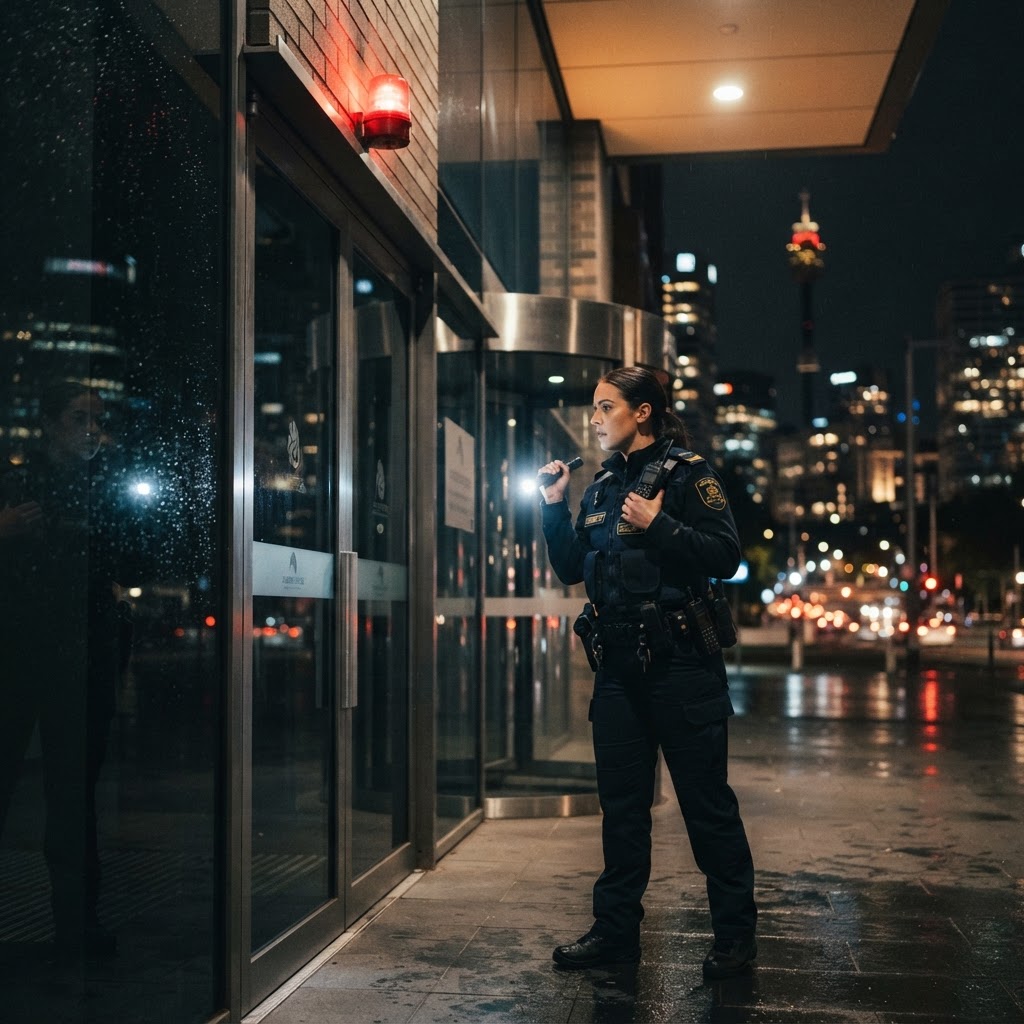
It's 9pm on a Tuesday. Your office in Parramatta is empty, the last staff left at 6, and somewhere inside a motion sensor picks up movement where there shouldn't be any. Within seconds, a signal is already travelling to a monitoring control room on the other side of Sydney — and what happens in the next thirty minutes decides whether you arrive to a minor incident or a major loss.
For most Sydney business owners, alarm response is invisible until the night it matters. Yet it's the single point where an alarm system stops being a deterrent and becomes actual protection. Here's what really happens when a business alarm is triggered after hours — and what separates a professional response arrangement from an alarm that simply makes noise.
What Happens the Moment an Alarm Activates?
A modern back-to-base alarm doesn't rely on a siren alone. When a sensor trips — motion, glass break, door contact or panic button — the panel sends a coded signal to a licensed monitoring centre, usually within seconds. The control room operator sees which zone activated, at what time, and whether it's the first event or part of a cascade.
This matters more than it sounds. A single sensor activating is ambiguous: it could be a curtain moving, a sensor fault, or a person moving through the building. A door contact followed by three interior sensors in sequence tells a very different story. Professional operators read that pattern before deciding the response — which is why back-to-base monitoring is dramatically more reliable than a siren on an empty Blacktown industrial estate.
The Response Sequence, Step by Step
When a signal arrives at the control room, a structured sequence follows:
- Signal verification — the operator checks the activation pattern, site history and any CCTV or audio verification attached to the system
- Site procedures — your site's response plan determines what happens next: who to call, in what order, and whether a patrol dispatch is authorised
- Patrol dispatch — if the plan calls for it, a licensed mobile patrol officer is dispatched to physically attend the premises
- On-site inspection — the officer checks the perimeter, entry points and the specific zone that activated
- Escalation — police are called where there's evidence of entry or an offence in progress; you or your nominated keyholder are contacted with a written report either way
The whole point of this sequence is speed with judgment. A patrol can typically reach a site faster than police will attend a non-verified alarm, and a trained officer can tell the difference between a burst tube light and a broken window.
Who Actually Turns Up?
In NSW, the people who respond to your alarm matter legally as well as practically. Security work — patrols, guarding and monitoring — is regulated under the Security Industry Act 1997 and administered by SLED (the NSW Security, Enforcement and Licensing Directorate). Anyone attending your site on a paid security basis must hold the appropriate licence, and the company dispatching them must hold a Master Security Licence.
When you're comparing providers across Sydney, ask directly:
- Who attends an activation — your provider's own licensed officers, or an unnamed subcontractor?
- Is every patrol visit GPS-verified with a written incident report?
- What's the documented escalation procedure if the officer finds a door open, damage, or an offender on site?
- Is the response arrangement written into your service agreement, or just implied?
If those questions get vague answers, keep shopping. The night your alarm goes off is the wrong time to discover your "monitoring" was only ever a siren and a voicemail.
Why Sirens Alone Don't Protect Empty Premises
Many businesses in Sydney's industrial and commercial districts — from Banksmeadow and Silverwater through to Castle Hill and Norwest — rely on an audible alarm and good will. The uncomfortable reality is that after-hours, nobody is listening. Neighbouring units are empty, passing traffic is thin, and even a loud siren gets reported, if at all, only after it's been ringing for a long time.
A monitored alarm inverts the model: instead of hoping someone notices your alarm, a control room whose entire job is to notice it is watching the signal from the moment it fires. Combined with a mobile patrol response, the gap between activation and a trained set of eyes on your premises shrinks from hours to minutes.
False Alarms: The Hidden Cost of a Bad Setup
A well-configured system rarely generates false activations. A badly configured one calls patrol officers out constantly — and repeated false callouts have real costs: fees on some response plans, frustration for everyone involved, and eventual desensitisation where a genuine activation gets treated as "probably another false one".
Professional providers reduce false alarms by getting the basics right: correct sensor selection for the space, proper pet-and-plant masking where needed, secure door contacts on every entry point, and a maintenance schedule that catches failing sensors before they start chattering. If your current system generates regular false activations, that's a maintenance issue — not a reason to abandon monitoring.
What a Response Plan Should Cover
Before an alarm ever activates, your provider should sit down with you and document a site-specific plan. At a minimum it should cover:
- Which activations trigger a patrol dispatch versus a phone call
- Who the nominated keyholders are, in what order, with current contact numbers
- When police are called, and by whom
- What an officer does on arrival — full perimeter check or specific zone inspection
- How and when you receive the incident report
This is also where commercial security design earns its keep: matching the response to the actual risk of each site rather than selling every business the same package.
CCTV and Alarm Response Work Better Together
The strongest after-hours setups pair alarm monitoring with CCTV monitoring. When a motion alarm triggers, the control room can visually verify what's happening on site before dispatching — confirming a genuine entry in seconds or standing down an activation caused by a banner blown loose across a camera. Verification makes response faster when it's real and cheaper when it's not, and recorded footage gives police something actionable if there is an incident.
Frequently Asked Questions
How fast does a patrol respond to an alarm in Sydney?
Response times depend on distance and traffic, but a licensed patrol can typically attend within the surrounding suburb network — generally under an hour across most of the Sydney basin, and often much faster where the patrol vehicle is already working nearby. If guaranteed response times matter to you, have them written into the service agreement.
Does an alarm automatically call the police in NSW?
No. Police are dispatched based on the response plan and the evidence available. A control room will call police where there's verification of an offence — CCTV confirmation, multiple activation zones, or a patrol officer reporting signs of entry. That's why monitoring with verification gets a better police response than an unverified siren.
Can I get alarm response for my business if I already have an alarm installed?
In most cases, yes. Existing alarm panels can usually be connected to back-to-base monitoring with little or no hardware change. A provider should test the panel, confirm it reports correctly to the control room, and document your response plan.
What does the patrol officer actually do on site?
A full perimeter inspection: fences, doors, windows and the zone that activated, then interior access if the response plan authorises it and entry is safe. Findings, photos and actions taken are documented in a written report to the keyholder.
Be Ready Before the Alarm Sounds
After-hours alarm response is one of the least expensive, highest-impact layers of security a Sydney business can add — but only if it's set up properly. A licensed control room, a documented response plan and verified patrol attendance turn your alarm from noise into a system that protects people and property while you're not there. If your current arrangement is a siren and a hope, it's worth a conversation about what a genuine response setup looks like for your site.